Sorry for the hiatus from posting, but I'm pleased to have some good news for once - the experimental antibiotics we've been trying are working beautifully. Due to company policy, I unfortunately cannot reveal much more information about the specific drug tested; however, I can say that it was a quinolone antibiotic. I knew I was on to something with that drug family, and it looks like I was right! If further trials work out, this drug might be the antibiotic that kills off this nasty, destructive bug in suffering victims...
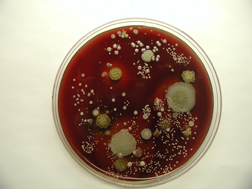
I do have one more update - remember my pet project plate from a couple months back? Well, I continued monitoring it, checking on the growth of the colonies. Turns out that the grey colonies are most likely penicillium mold, while the other unknown colonies were S. mutans, a Strep strain commonly found in the human mouth as dental plaque. I'm not sure how penicillium got onto this plate or why it hasn't retarded bacterial growth yet, but as for the S. mutans I suspect that omeone must have coughed into the plate, soiling the sample. After identifying the grey colonies, I allowed the plate to sit another week, and that's when I began to notice something - both the mold and S. mutans colonies were dying off, and the Masque colonies were becoming more numerous.
The fact that the Masque colonies resisted intrusion from the penicillium colonies is no surprise to me, since this strain is immune to the effects of penicillium mold. But unless there's an antibiotic present in the agar, which there was, colonies shouldn't spontaneously die off like that - especially not penicillium. At first, I thought that it was indeed the quinolone treatment in the agar that had killed the S. mutans colonies, but to confirm I did test the agar for traces of the antibiotic. What I found shocked me.
There was no antibiotic present on the plate, despite my having clearly remembered treating it.
My best guess is that the antibiotic degraded over time, possibly by exposure to sunlight. I'll be replicating this experiment with more Masque bacteria, penicillium spores from our own samples, and plaque samples from my own mouth just to be sure it's not a fluke. Besides, it's an excuse to continue my pet project, even as I continue my research into this devastating MRSA strain...
Friday, February 28, 2014

Friday, February 7, 2014
Pet Project
Hey, remember that contaminated plate from last post? I found something cool on it today - a mixture of bacteria! So, aside from the lost sample, I did get this nifty picture to show you:

Notice the large brown colonies of Staph present on this blood agar plate. That's the Masque strain sample that I plated. Depressingly, it seems that the particular fluroquinolone that I treated it with hasn't really done much good in controlling the colonies - there's fewer of them, but they're also larger. Notice also the greyish colonies. I have not yet identified these bacteria, but I'll be sure to give you an update as soon as I do. Until then, I'll continue to keep you posted on the Masque project.
Notice the large brown colonies of Staph present on this blood agar plate. That's the Masque strain sample that I plated. Depressingly, it seems that the particular fluroquinolone that I treated it with hasn't really done much good in controlling the colonies - there's fewer of them, but they're also larger. Notice also the greyish colonies. I have not yet identified these bacteria, but I'll be sure to give you an update as soon as I do. Until then, I'll continue to keep you posted on the Masque project.
Monday, February 3, 2014
Unfortunate Setback
No, no, no!
Someone left one of the fluoroquinolone-treated samples open over the weekend and didn't tell me. It's contaminated with God only knows what microflora now... I saw what looked to be like some kind of mold, and possibly E. coli from the food processing lab, meaning that someone didn't change their gloves - likely one of the lab techs on the Masque project.
So frustrated. Now I have to scrap the sample and start all over, and what's worse, I'll likely have to remove whomever didn't follow protocol from the project. I really hate having to get people in trouble with the higher-ups, but if protocol for highly contagious pathogens is broken, it could get all of us endangered or infected. It's a risk we just can't take...
Out of personal interest, I'll keep the contaminated sample separate from the others; I'd like to see if the Masque strain plays nice with other microflora. As for the setback, let's just hope that the rest of the week is better than this one was... :(
Someone left one of the fluoroquinolone-treated samples open over the weekend and didn't tell me. It's contaminated with God only knows what microflora now... I saw what looked to be like some kind of mold, and possibly E. coli from the food processing lab, meaning that someone didn't change their gloves - likely one of the lab techs on the Masque project.
So frustrated. Now I have to scrap the sample and start all over, and what's worse, I'll likely have to remove whomever didn't follow protocol from the project. I really hate having to get people in trouble with the higher-ups, but if protocol for highly contagious pathogens is broken, it could get all of us endangered or infected. It's a risk we just can't take...
Out of personal interest, I'll keep the contaminated sample separate from the others; I'd like to see if the Masque strain plays nice with other microflora. As for the setback, let's just hope that the rest of the week is better than this one was... :(
Wednesday, January 29, 2014
It's A Secret :)
Sorry readers, but due to a change in what antibiotics are being tested now, I can't share details of the testing procedures I'm using for the Masque project anymore. The reason for this is that the drugs I'm testing are very new, unreleased antibiotics that have recently been approved for testing, and I'm not legally allowed to share details about them or I could lose my job.
I'll continue to give updates on the Masque project, but they're likely going to be more infrequent and less detailed. Sorry. :(
I'll continue to give updates on the Masque project, but they're likely going to be more infrequent and less detailed. Sorry. :(
Monday, January 27, 2014
Types of Antibiotics
I had a couple readers shoot me an email concerning differences in the types of antibiotics used to treat bacterial infections. There are hundreds of antibiotics out there, but most are classified into six main families. Here is a quick overview of the different antibiotic families:
- Penicillins are widely used to treat a variety of infections, including skin infections, chest infections and urinary tract infections. They're the most common kind of antibiotic available.
- Cephalosporins can be used to treat a wide range of infections but are also effective in treating more serious infections such as sepsis and meningitis.
- Aminoglycosides tend to be used only to treat very serious illnesses such as sepsis, as they can cause serious side effects, including hearing loss and kidney damage. They break down quickly inside the digestive system so they have to be given by injection. They are also used as drops for some ear or eye infections.
- Tetracyclines can be used to treat a wide range of infections. They are commonly used to treat moderate to severe acne and rosacea. Most people respond well to this antibiotic.
- Macrolides can be particularly useful in treating lung and chest infections. They can also be a useful alternative for people with a penicillin allergy or to treat penicillin-resistant strains of bacteria like MRSA.
- Fluoroquinolones or Quinolones are broad-spectrum antibiotics that can be used to treat a wide range of infections. These tend to be particularly effective on Staph strains.
Friday, January 24, 2014
Second Week Results
The fluoroquinolones continue to show great promise in destroying colonies of the Masque Disease, as the ever-hovering media seems fit to dub it. All in all, the research into using macrolide antibiotics was scrapped, as results with them continued to be highly unfavorable.
We will continue research into using fluoroquinolones, and in the meantime I'll get back to posting your regularly scheduled disease facts and info. Stay tuned. :)
We will continue research into using fluoroquinolones, and in the meantime I'll get back to posting your regularly scheduled disease facts and info. Stay tuned. :)
Thursday, January 16, 2014
First Week Results
The results of the first battery of tests is in, and they are unfortunately quite disappointing.
Tested antibiotics included the following: balofloxacin, clinafloxacin, levofloxacin, moxifloxacin, erythromycin, clarithromycin, tylocin, and telithromycin. They were all tested at both high and low concentrations, with the following less than stellar results.
Tested antibiotics included the following: balofloxacin, clinafloxacin, levofloxacin, moxifloxacin, erythromycin, clarithromycin, tylocin, and telithromycin. They were all tested at both high and low concentrations, with the following less than stellar results.
- clinafloxacin killed colonies only at doses lethal to humans.
- erythromycin, clarithromycin, and tylocin failed to kill any colonies even at the highest doses.
- balofloxacin and levofloxacin seem promising, working at low doses, killing about half the colonies in the agar.
- telithromycin seems to work only at high doses.
Monday, January 13, 2014
Antibiotic Testing
Today's the day, readers! I'm finally set to start research on MRSA serotype Masque, particularly in testing antibiotics. It's been confirmed by Dr. Wahlburn, who is working on the project with me, that the bacterium is indeed resistant to Penicillin, Cephalosporin, and weaker Tetracyclines. More research into the Tetracycline drug family may be necessary, as inadequate research was done on the stronger members of that drug family due to time constraints. Also tested will be trials involving Fluroquinolones and Macrolides. MRSA infections have previously responded favorably to Macrolide antibiotics in particular, so it's my hope that the same is the case with Masque.
Wish me the utmost luck; I'm about to dive into this project full force. I'll be sure to keep you updated as research continues.
Wish me the utmost luck; I'm about to dive into this project full force. I'll be sure to keep you updated as research continues.
Friday, January 10, 2014
Home, Sweet Home
Finally back in Maryland again, after a long, long stay in Cali - and I've brought a new friend along, as promised. I've managed, through cooperation with the West Coast Branch of the CDC, to obtain three agar plates of the Masque MRSA strain. The little guys are safe and sound (and well protected!) inside a sterile metal incubating box, which I personally drove all the way home with (it's illegal to ship infectious material through the United States Mail). Quite a trip, let me tell you! The agar plates have made it home safe and sound, and are being kept on premise in the lab in their own hermetically sealed, high-level biohazard area. Only I and a few other scientists are allowed into that room to test the bacteria, and biohazard suits are a must while working with the samples, as per usual.
I unfortunately have more bad news for my readers in California - it seems that there has been an uptick in patients being treated at hospitals in that state after seeking emergency medical treatment for Masque serotype MRSA infections. It seems the disease has become quite infectious and is no longer an issue for only those who are sick or hospitalized. The West Coast Branch is working around the clock to ensure the safety of citizens in and around the Orange County, Los Angeles, and San Francisco areas. Remember to take special care to commit to personal hygiene, such as hand-washing, treating wounds promptly, and seeking medical attention if you at any time suspect a staph infection.
I unfortunately have more bad news for my readers in California - it seems that there has been an uptick in patients being treated at hospitals in that state after seeking emergency medical treatment for Masque serotype MRSA infections. It seems the disease has become quite infectious and is no longer an issue for only those who are sick or hospitalized. The West Coast Branch is working around the clock to ensure the safety of citizens in and around the Orange County, Los Angeles, and San Francisco areas. Remember to take special care to commit to personal hygiene, such as hand-washing, treating wounds promptly, and seeking medical attention if you at any time suspect a staph infection.
Wednesday, January 8, 2014
Update on the MRSA Strain Project...
It's been awhile, but I've finally found time to sit down and blog again!
I know you've all been anxious to hear about my research out in California. Well, I've got some interesting news about it, a little good and a little bad.
The good news is, we've discovered a new strain of MRSA prevalent in hospitals in the California area, but it hasn't seemed to spread to other states yet. It's our hope that the spread can be prevented by early intervention, before anyone else is harmed.
Now comes the bad news. This next part is rather disturbing - squeamish readers may want to skip to the bottom of this post.
As it turns out, we're not dealing with your garden-variety MRSA here, as this strain is particularly dangerous and might be resistant to even more antibiotics than before. Some of my readers might remember my MRSA post from last year, when I mentioned that necrosis and gangrene are complications of an untreated staph infection. Unfortunately, it seems that this particular strain is quite nasty in that regard, as in 85% of all infections with this strain, necrosis and tissue death occurs. It seems this particularly vicious strain tends to concentrate in the tissues of the face in about 73% of all cases. In these cases, the necrosis occurs in a predictable pattern - spreading in a ring-like shape outward from both eyes and down the nose in a mask-like pattern. The disease also tends to necrotize areas over any bony parts of the body, meaning that pressure sore wounds are very commonly infected areas of the body as well. Bleeding and pus occur readily around still-living areas of infection as well, while dead tissue turns gangrenous and black before sloughing off. As you can imagine, this causes significant facial damage, and can even result in death. This necrosis occurs rapidly over the course of a few days, with eye, nose, and mouth infections being common due to their proximity with the infected area. Nerve death and bacterial menengitis are deadly but rare complications of infection. The risk of sepsis is particularly high with this strain as well, occurring in about 48% of all cases.
The mortality rate for this strain of MRSA is currently around 85-90% without hospital treatment and occurs within a week after infection; with timely hospital intervention the death rate drops to about 65%. The elderly, the immunocompromised, and infants are at the greatest risk for contracting this deadly staph strain. However, it gets worse - this particular strain, in addition to being resistant to Methicillin and other drugs like it, is resistant to cephalosporins and tetracyclines, two other common types of antibiotics, making this one bad, bad bacterium that is difficult to treat effectively.
Due to the predictable pattern of this strain's spread and its disastrous effects, I have dubbed this strain the "Masque" serotype of MRSA, and I plan to bring samples of the bacterium with me to test later. There are other options for antibiotics that have not yet been tested, and my superiors are quite interested in studying this fascinating and deadly little "superbug". I will keep my readers posted on any more developments with the project. In the meantime, I highly suggest my Californian readers take extra precautions if they may be exposed to Staph bacteria, particularly if they work with children or in health care.
I know you've all been anxious to hear about my research out in California. Well, I've got some interesting news about it, a little good and a little bad.
The good news is, we've discovered a new strain of MRSA prevalent in hospitals in the California area, but it hasn't seemed to spread to other states yet. It's our hope that the spread can be prevented by early intervention, before anyone else is harmed.
Now comes the bad news. This next part is rather disturbing - squeamish readers may want to skip to the bottom of this post.
As it turns out, we're not dealing with your garden-variety MRSA here, as this strain is particularly dangerous and might be resistant to even more antibiotics than before. Some of my readers might remember my MRSA post from last year, when I mentioned that necrosis and gangrene are complications of an untreated staph infection. Unfortunately, it seems that this particular strain is quite nasty in that regard, as in 85% of all infections with this strain, necrosis and tissue death occurs. It seems this particularly vicious strain tends to concentrate in the tissues of the face in about 73% of all cases. In these cases, the necrosis occurs in a predictable pattern - spreading in a ring-like shape outward from both eyes and down the nose in a mask-like pattern. The disease also tends to necrotize areas over any bony parts of the body, meaning that pressure sore wounds are very commonly infected areas of the body as well. Bleeding and pus occur readily around still-living areas of infection as well, while dead tissue turns gangrenous and black before sloughing off. As you can imagine, this causes significant facial damage, and can even result in death. This necrosis occurs rapidly over the course of a few days, with eye, nose, and mouth infections being common due to their proximity with the infected area. Nerve death and bacterial menengitis are deadly but rare complications of infection. The risk of sepsis is particularly high with this strain as well, occurring in about 48% of all cases.
The mortality rate for this strain of MRSA is currently around 85-90% without hospital treatment and occurs within a week after infection; with timely hospital intervention the death rate drops to about 65%. The elderly, the immunocompromised, and infants are at the greatest risk for contracting this deadly staph strain. However, it gets worse - this particular strain, in addition to being resistant to Methicillin and other drugs like it, is resistant to cephalosporins and tetracyclines, two other common types of antibiotics, making this one bad, bad bacterium that is difficult to treat effectively.
Due to the predictable pattern of this strain's spread and its disastrous effects, I have dubbed this strain the "Masque" serotype of MRSA, and I plan to bring samples of the bacterium with me to test later. There are other options for antibiotics that have not yet been tested, and my superiors are quite interested in studying this fascinating and deadly little "superbug". I will keep my readers posted on any more developments with the project. In the meantime, I highly suggest my Californian readers take extra precautions if they may be exposed to Staph bacteria, particularly if they work with children or in health care.
Subscribe to:
Posts (Atom)